Contents
1 What is TCLP ?
TCLP is a type checker for Prolog/CLP(X). TCLP thus aims to
introduce a typing discipline to contraint logic programming. That
is, given a description of the types’ universe, and the set
of the types of used function symbols, TCLP will check the
coherence of the use of these function symbols. TCLP take the
program plus any type definitions as input and will output the type
of infered predicates plus any errors w.r.t. the type checking.
Currently TCLP comes with definitions for three Prolog/CLP(X)
dialects: ISO-Prolog, GNU-Prolog (with CLP(FD) extension) and
SICStus Prolog with its libraries (including the constraint
programming libraries CLP(B), CLP(FD), CLP(QR), CHR).
TCLP has been written in SICStus Prolog and comes in three
forms: an online
demo (Section 2), a SICStus Prolog
library
(Section 4) and a command
line tool (Section 3).
1.1 Features
- Uses three kinds of polymorphism:
- parametric polymorphism (e.g.
list(α))
- subtyping (e.g. list(α) < term)
- overloading (i.e. ad hoc polymorphism, like
- : int × int −> int
and - : α×β −>
pair(α,β)
- Is able to infer a heuristic type for
predicates
- Default type term or atom for
undeclared function symbols
- Possibility to define your own clause syntax
(ex :+ instead of :- in CLP(FD) constraint
definitions)
2 Online demo
2.1 Quick start
You can find the online demo at:
http://contraintes.inria.fr/~coquery/tclp/exemples/demo.en.html.
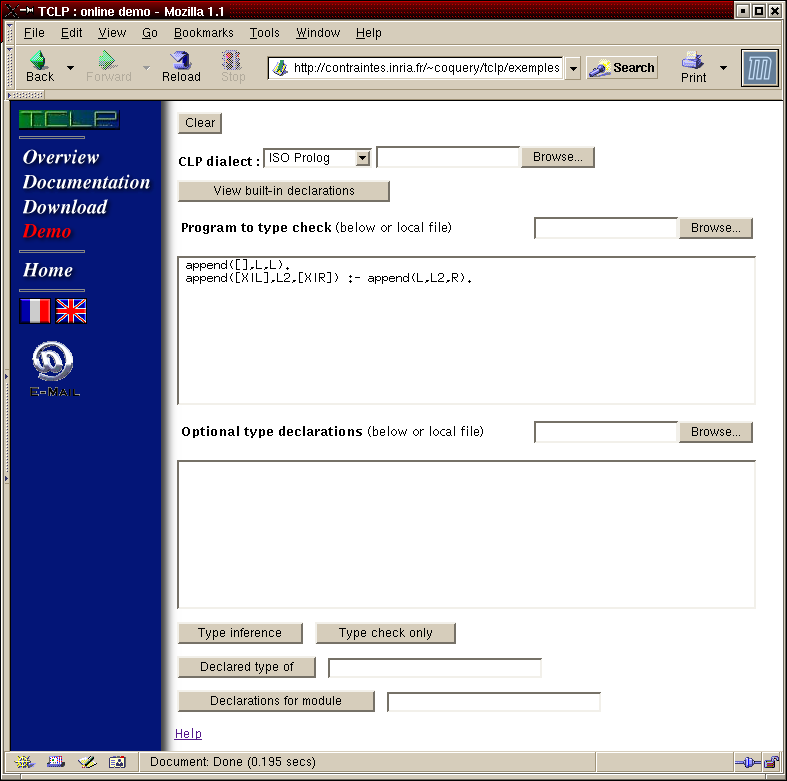
There you can try to type check some programs by writing them
into the “Program to type check” area, ex:
- append([],L,L).
append([X|L],L2,[X|R]) :- append(L,L2,R).
By clicking on the type inference button, you will get
the following result:
- %% tclp 0.2.99g
- %% starting type checking ...
- :- typeof append(list(A),list(A),list(A))
is pred.
- %% finished
You can also tell TCLP what Prolog/CLP dialect you are using
with CLP dialect box.
2.2 Advanced usage
Here is a description of the different options you can use in
the online demo:
- Clear clears the form.
- CLP dialect allows one to choose
which Prolog/CLP dialect the program to type check is made for. You
can choose either ISO Prolog, GNU Prolog,
SISCtus Prolog or load your own type library with
Other (file) and the Browse ... button on the
right.
- View built-in declarations allows you
to view the type definitions for the selected dialect.
- Program to type check: The source of
the program to type check must be placed on this area. You can also
use the Browse ... button to use one of your own file
directly instead of copying it into the area.
- Optionnal type declaration: you can
put any type declaration in this area. You can also load them using
the Browse ... button.
- Type inference starts the type check
the program. The type of unknown predicates defined in the program
source will be infered
- Type check only starts the type
checking of the program. Does not infer the type of unknown
predicates.
- Declared type of prints the type of
the given predicate or functor on the right. The syntax can be of
the following forms:
- append
- append/3
- append/X
- append(X,Y,Z)
- Declarations for module prints the
content of the .typ file for the given module. This is
useful if you want to know available predicates and data structures
of a peticular module.
3 Command line tool
3.1 Install
You can download the binaries at the following location:
http://contraintes.inria.fr/~coquery/tclp/download.en.html
3.1.1 Linux / MacOS X
Extract the archive in some folder, enter it and execute the
install script:
- tar xzvf tclp-i386-xxx.tgz
- cd tclp-xxx
- ./install.sh
Install options:
- –prefix <dir> the
directory where TCLP files and directories will be installed
(defaults to /usr/local)
- –bindir <dir> the
directory where the tclp executable will be installed,
which should be in your PATH environment variable
(defaults to prefix/bin)
- –tclpdir <dir> the
directory where TCLP files will be installed (defaults to
prefix/tclp)
3.2 Get started
Basically, you just have to run on your file:
tclp file.pl
Example:
$ ../Devel/tclpchr/bin/tclp append.pl
%% tclp 0.3
%% tclp directory: /home/gewurz/coquery/Devel/tclpchr/bin
:- typeof append(list(A),list(A),list(A)) is pred.

$
3.3 Command line options
Usage:
tclp [ --prolog <dialect> ] [ -I <dir> ]
[ --stdlib <file> ] [ -v <sort> | -nv <sort> ] [
-i | --type_inference | --type_check ] [ -l | -nl ] [ --help ]
<file> [ <files> ]
- --prolog
<dialect>
- <dialect> is the name of
a prolog dialect. This option causes TCLP to use type definitions
for the corresponding dialect. Currently, available dialects are:
- ISO: ISO Prolog (default)
- gprolog: GNU Prolog
- sicstus: SICStus Prolog
- -I <dir>
- This options adds <dir>
to the list of directories where TCLP looks for files.
- --stdlib
<file>
- Makes TCLP use <file> as
the standard type library (for built-in predicates). By default
TCLP will use the first file named stdlib.typ in the
lookup directories (which contains the dialect directory
tclpdir/lib/dialect).
- -v <sort>
- Enable verbose mode for
<sort>, where <sort> can be either:
- actions: prints the different
actions of TCLP , like, e.g., loading a type library.
- timing: prints CPU time used by
TCLP for different actions.
- defaults: output a message each
time TCLP encounters a term that has no defined type. This can be
useful to understand some error messages.
- types: prints the type of each
infered predicate (this is activated by default)
- -nv
<sort>
- Disables verbose mode for
<sort>.
- -i,
--type_inference
- Enables predicate type inference (this
is activated by default).
- --type_check
- Disables predicate type inference.
- --help
- Prints the different options.
4 SICStus Prolog library
4.1 Install and get started
You can download the library at the follwing location:
http://contraintes.inria.fr/~coquery/tclp/download.en.html
Just extract the archive where who want the library to be
installed. To install the library as a SICStus Prolog library,
extract it to a temporary folder and copy the files in the
directory tclp-xxx to the SICStus Prolog library directory
(e.g. /usr/local/lib/sicstus-3.9.1/library).
The library can be loaded with the use_module
directive:
- :-
use_module(’tclp-installation-directory/tclp’)
- or :- use_module(library(tclp)) if the
TCLP library is installed into the SICStus Prolog library
directory.
Then you must choose the prolog dialect of the files to type
check, using one of the following predicates:
- iso/0: the initializes TCLP for ISO
dialect
- gnu/0: the initializes TCLP for GNU
Prolog dialect
- sicstus/0: the initializes TCLP for
SICStus Prolog dialect
You can type check files and load types using the
tclp/1 predicate:
- :- tclp(’file1.typ’).
- :- tclp([’file2.typ’,
’file3.pl’]).
- ...
4.2 Available predicates
These predicate are available in the TCLP library
4.2.1 Type initialization
- tclp__reinit
- Remove all types from the current type
data base and reload the types corresponding to the current
dialect, using tclp__reinit/1 and
user:init_dialect/1.
-
tclp__reinit(+Goal)
- Remove all types from the current type
data base, executes Goal and real the standard
library according to the current settings (usually, Goal
is used to determine these settings).
-
tclp__set_dialect(+Dialect)
- Sets the current CLP dialect to
Dialect.
-
user:init_dialect(+Dialect)
- This is a dynamic predicate used by
tclp__reinit/0.
- sicstus
- Sets the dialect to SICStus Prolog and
reinits the types.
- iso
- Sets the dialect to ISO Prolog and
reinits the types.
- gnu
- Sets the dialect to GNU Prolog and
reinits the types.
4.2.2 Processing
-
tclp(+FileOrFiles)
- FileOrFiles is either
on file name or a list of file names. TCLP first loads
’.typ’ files of FileOrFiles,
then reads and type checks ’.pl’ files of
FileOrFiles.
-
tclp__process_typ(+FileOrFiles)
- FileOrFiles is a file
or a list files. TCLP loads TCLP declarations in these files.
-
tclp__process_pl(+FileOrFiles)
- FileOrFiles is a file
or a list files. TCLP reads Prolog programs in these files and type
check them.
-
tclp__process_phrases(+PhraseList)
- PhraseList is a list
of pairs Phrase-Location, where
Phrase is a phrase to type check and
Location is some information about the phrase,
given by tclp__reader:read_one_term(Stream,
Phrase, Location, FileName).
-
tclp__set_inference(+TrueFalse)
- TrueFalse is either
true or false. This predicate en(dis)ables type
predicate inference in TCLP.
-
tclp__add_search_directory(+Directory)
- Directory is a
directory name. This predicate adds Directory to
the directories used by TCLP for file lookup.
-
tclp__set_stdlib_name(+File)
- Sets the name of the file to load as the
standard type library to File.
-
tclp__enable_verbose(+Sort)
- Enables verbose mode for
Sort, where Sort can be one of:
- actions: prints the different
actions of TCLP , like, e.g., loading a type library.
- timing: prints CPU time used by
TCLP for different actions.
- defaults: output a message each
time TCLP encounters a term that has no defined type. This can be
useful to understand some error messages.
- types: prints the type of each
infered predicate (this is activated by default)
-
tclp__disable_verbose(+Sort)
- Disables verbose mode for
Sort, where Sort can take the
values above.
4.2.4 The tclp() path alias
The loading of the tclp module will cause a path alias
’tclp’ to be created. This alias can used,
either to load a module of the TCLP implementation (like
tclp(tclp__reader)) or to access the type files for ISO
(resp. GNU and SICStus) Prolog using
tclp(’lib/ISO/file.typ’) (resp.
tclp(’lib/gprolog/file.typ’) and
tclp(’lib/sicstus/file.typ’).
5 Syntax of TCLP declarations
5.1 Syntax of types
| type |
::= |
symbol( type ,
... , type ) |
| |
| |
symbol |
| |
| |
variable |
| symbol |
: |
a prolog atom, which corresponds
to a type constructor |
| variable |
: |
a prolog variable, which
corresponds to a type parameter |
5.2 Type declaration
- :- order
Type1(A1, ... , AM) <
Type2(B1, ... , BN)
- Declares that the type constructor
Type1 is smaller than the type constructor
Type2. The mapping are given by the arguments,
i.e. if AI == BJ then the I-th argument
of Type1 corresponds to the J-th argument of
Type2.
- :- typeof +TypedTerm is
+Type
- Declares a type for the given term.
TypedTerm is of the form
Name(Type1,...,TypeN), where
Type and TypeI are types.
Type1,...,TypeN are the types of the arguments
and Type is the type of the result.
- :- type
+TypeConstructor.
- Declares a type.
TypeConstructor is either of the form
Name/Arity or of the form
Name(A,B,...). It declares the existence of a
type named Name which have
Arity arguments.
- :- type +Type is
+TermConstructorList.
- Combinaison of type and typeof.
Type is of the form
Name(A,B,...) and +TermConstructorList
is alist of terms of the form
Name(Type1,...,TypeN). The
declared type is Type. The result type is
Type.
- :- untyped
+SpecOrSpecList.
- Avoid to type check the given terms.
SpecOrSpecList is a functor specification of the
form Name/Arity, or a list of such
specifications. It causes TCLP to avoid to type check these
terms.
5.3 TCLP meta declarations
- :-
tclp__include(+File)
- Include TCLP declarations found in
File.
- :-
user:args_location(+Location,?LocationList)
- This predicate decompose the location of
a term into the list of the locations of its subterms.
- :-
tclp__define_clause(+Phrase,+Location,+Heads,+Bodies,+Condition)
- This will tell TCLP what the clauses
look like. Phrase is the phrase to cut into
bodies and heads. Location is the location of the
phrase in the program source. Heads is a list of
triplets Head-HLocation-Type,
where Head is a head of the clause,
HLocation is the location of
Head in the program source (one can use
user:args_location/2 to find it) and
Type is the type expected for the head of the
clause. Bodies is a list of pairs
Body-BLocation, where
Body is a body of the clause and
BLocation is its location.
Condition is a goal executed when recognizing
clauses. E.g. (prolog directive “:- Body”):
- :- tclp__define_clause((:- Body), Location,
[], [Body-BodyLocation],
user:args_location(Location,[BodyLocation]))
- :-
tclp__define_clause(+Phrase,+Location,+Heads,+Bodies)
- Same as
tclp__define_clause(Phrase,Location,Heads,Bodies,true)
- :-
tclp__define_clause_op(+BinOp,+Type)
- This predicate is a shortcut of
tclp__define_clause/5 for defining binary clause operators
such as ’:-’/2. BinOp is the
name of the operator and Type is the type
expected for the head of the clause. E.g.
- :-
tclp__define_clause_op(’:-’,pred).
- :-
tclp__define_clause_op(+BinOp)
- Same as
tclp__define_clause_op(BinOp,pred)
- :-
tclp__executable(+Goal,+Condition)
- Tells TCLP that the goal
Goal is a TCLP declaration if the goal
Condition succeeds. E.g. the op/3
directive:
- :-
tclp__executable(op(_,_,_),true).
- :-
tclp__executable(+Goal)
- Same as
tclp__executable(+Goal,true)
- :-
tclp__add_hook(+Goal,+Location,+Hook,+Condition)
- Whenever TCLP encounters a TCLP
declaration, it will handle it using a hook defined via this
predicate. Goal is the TCLP declaration,
Location is its location in the program source,
Hook is the goal that will be executed by TCLP to
handle the declaration and Condition is a goal
that must succeed. E.g. the op/3 directive:
- :-
tclp__add_hook(op(Priority,Mode,Operators), _,
op(Priority,Mode,Operators), true).
- :-
tclp__add_hook(+Goal,+Location,+Hook)
- Same as
tclp__add_hook(Goal,Location,Hook,true)
- :-
tclp__add_hook(+Goal,+Hook)
- Same as
tclp__add_hook(Goal,_,Hook)
5.4 Dialect specific declarations
- :-
tclp__load_prolog(+File)
- Causes TCLP to consult
File is in consult/1. This can be useful
if you want to define complex treatments of some TCLP
declarations.
6 Limitations
- modules
- Currently, TCLP only loads .typ
files automatly when it encounters the directives
use_module/[123] and module/2. The functor
’:’/2 is not handled. Moreover if two
predicates with the same name and arity exists in two different
modules, they will be considered as the same predicate by
TCLP.
A TCLP source files
- tclp.pl
- This the main file for the library. It
mainly consists in wrappers for calling predicates in other TCLP
modules.
- tclp__main.pl
- The main file for the command line
tool.
- tclp/tclp__arity.pl
- The file contains predicates for
handling depandancies between the arguments of the different type
constructors.
- tclp/tclp__arrays.pl
- Defines dynamic arrays with predicates
to manipulate them.
- tclp/tclp__clp_types.pl
- Defines the solver for constraints over
subtyping inequalities.
- tclp/tclp__connexity.pl
- Handles the computation of mutually
recursive predicates in the program source, as well as the order in
which the clauses must be type checked.
- tclp/tclp__declarations.pl
- Defines the core meta declarations of
TCLP.
- tclp/tclp__def.pl
- Some constants definitions.
- tclp/tclp__errors.pl
- Handles printing of errors and warning.
Also handles the verbose predicates (should be in an IO module I
think)
- tclp/tclp__files.pl
- Handles file loading, file names, etc
...
- tclp/tclp__functor_types.pl
- Handles the typing of the application of
a functor to its arguments. In particular, it handles the treatment
of overloading.
- tclp/tclp__handle_goals.pl
- Core handling TCLP definitions.
- tclp/tclp__reader.pl
- Reads source phrases and handle their
location in the program source.
- tclp/tclp__type_checker.pl
- Type checking predicates.
- tclp/tclp__type_inference.pl
- Defines how the inference of the type of
predicates.
- tclp/tclp__type_order.pl
- Handles the order between type
constructors.
- tclp/tclp__utils.pl
- Miscellaneous predicates.
- tclp/version.pl
- The version TCLP.
- tclp/sicstus_modules.pl
- Predicates to handle some SICStus Prolog
directives (e.g. use_module/1).
B TCLP .typ files
- ISO Prolog
-
- lib/ISO/corelib.typ
- Meta definitions for ISO Prolog.
Included from lib/ISO/stdlib.typ.
- lib/ISO/stdlib.typ
- Standard type library for ISO
Prolog.
- GNU Prolog
-
- lib/gprolog/corelib.typ
- Meta definitions for GNU Prolog.
Included from lib/gprolog/stdlib.typ
- lib/gprolog/stdlib.typ
- Standard type library for GNU
Prolog.
- SICStus Prolog
-
- lib/sicstus/corelib.typ
- Meta definitions for SICStus Prolog.
Included from lib/sicstus/stdlib.typ
- lib/sicstus/stdlib.typ
- Standard type library for SICStus
Prolog.
- lib/sicstus/prolog.typ
- Internal type library for SICStus
Prolog. You need this one for predicates used with the
prolog:predicate(...) prefix.
- lib/sicstus/arrays.typ
- types for SICStus module arrays
- lib/sicstus/assoc.typ
- types for SICStus module assoc
- lib/sicstus/attributes.typ
- types for SICStus module atts
- lib/sicstus/bdb.typ
- types for SICStus module bdb
- lib/sicstus/charsio.typ
- types for SICStus module charsio
- lib/sicstus/chr.typ
- types for SICStus module chr
implementing the CHR extension. It contains meta definitions to
handle the solver definitions (e.g.
’<=>’/2).
- lib/sicstus/clpb.typ
- types for SICStus module clpb
implementing the CLP(B) extension
- lib/sicstus/clpfd.typ
- types for SICStus module clpfd
implementing the CLP(FD) extension. It contains meta declarations
to handle contraints definitions (e.g.
’:+’/2).
- lib/sicstus/clpq.typ,
lib/sicstus/clpr.typ and
lib/sicstus/clpqr.typ
- types for SICStus modules clpr, clpq and
clpqr implementing extension CLP(Q) and CLP(R).
- lib/sicstus/fastrw.typ
- types for SICStus module fastrw
- lib/sicstus/heaps.typ
- types for SICStus module heaps
- lib/sicstus/jasper.typ
- types for SICStus module jasper
- lib/sicstus/linda.typ
- types for SICStus module linda
- lib/sicstus/lists.typ
- types for SICStus module lists
- lib/sicstus/ordsets.typ
- types for SICStus module ordsets
- lib/sicstus/queues.typ
- types for SICStus module queues
- lib/sicstus/random.typ
- types for SICStus module random
- lib/sicstus/sockets.typ
- types for SICStus module sockets
- lib/sicstus/system.typ
- types for SICStus module system
- lib/sicstus/terms.typ
- types for SICStus module terms
- lib/sicstus/timeout.typ
- types for SICStus module timeout
- lib/sicstus/trees.typ
- types for SICStus module trees
- lib/sicstus/ugraphs.typ
- types for SICStus module ugraphs
- lib/sicstus/user.typ
- types for SICStus module user
- lib/sicstus/wgraphs.typ
- types for SICStus module wgraphs
This document was translated from
LATEX by HEVEA.