Generalization and Scaling Laws for Mixture-of-Experts Transformers
1. What is the problem?
Dense Transformers use nearly all their parameters for each input. In contrast, Mixture-of-Experts (MoE) Transformers contain many experts but activate only a few of them for each token. This makes MoE models attractive because the total model can be large while the per-token computation remains limited.
This creates a theoretical question: should the learning behavior of an MoE model be controlled by its total number of parameters, or by the smaller number of parameters that are active for each input?
2. Why is it difficult?
MoE models do not only add parameters. They also add a router. The router decides which experts are used for each token. This introduces many possible routing patterns, and these patterns can increase statistical complexity.
A clean theory therefore needs to distinguish two effects:
The number of parameters effectively used for a given input.
The number of possible ways tokens can be assigned to experts.
The empirical benefit of having many experts learn different regions or patterns.
3. Main theoretical message
The paper derives a generalization bound where the error decomposes into three terms: approximation error, estimation error, and routing overhead.
The first term measures how well the target function can be approximated with the active capacity. The second term is the usual statistical estimation term. The third term is specific to MoE models and comes from the number of possible routing patterns.
4. Meaning of the main quantities
- \(N_{\mathrm{act}}\): active parameter budget used for one input;
- \(n\): number of training samples;
- \(d\): intrinsic dimension of the data manifold;
- \(\beta\): smoothness of the target function;
- \(L_T\): number of Transformer layers;
- \(\ell\): sequence length;
- \(M\): total number of experts;
- \(k\): number of active experts selected by the router.
5. Scaling laws
When routing overhead is not dominant, the theory recovers dense-network scaling exponents, but measured with respect to active capacity rather than total capacity.
This means that MoE models can behave like dense models in terms of scaling exponents, provided that the correct notion of capacity is used: the active parameter budget.
6. Routing overhead and specialization
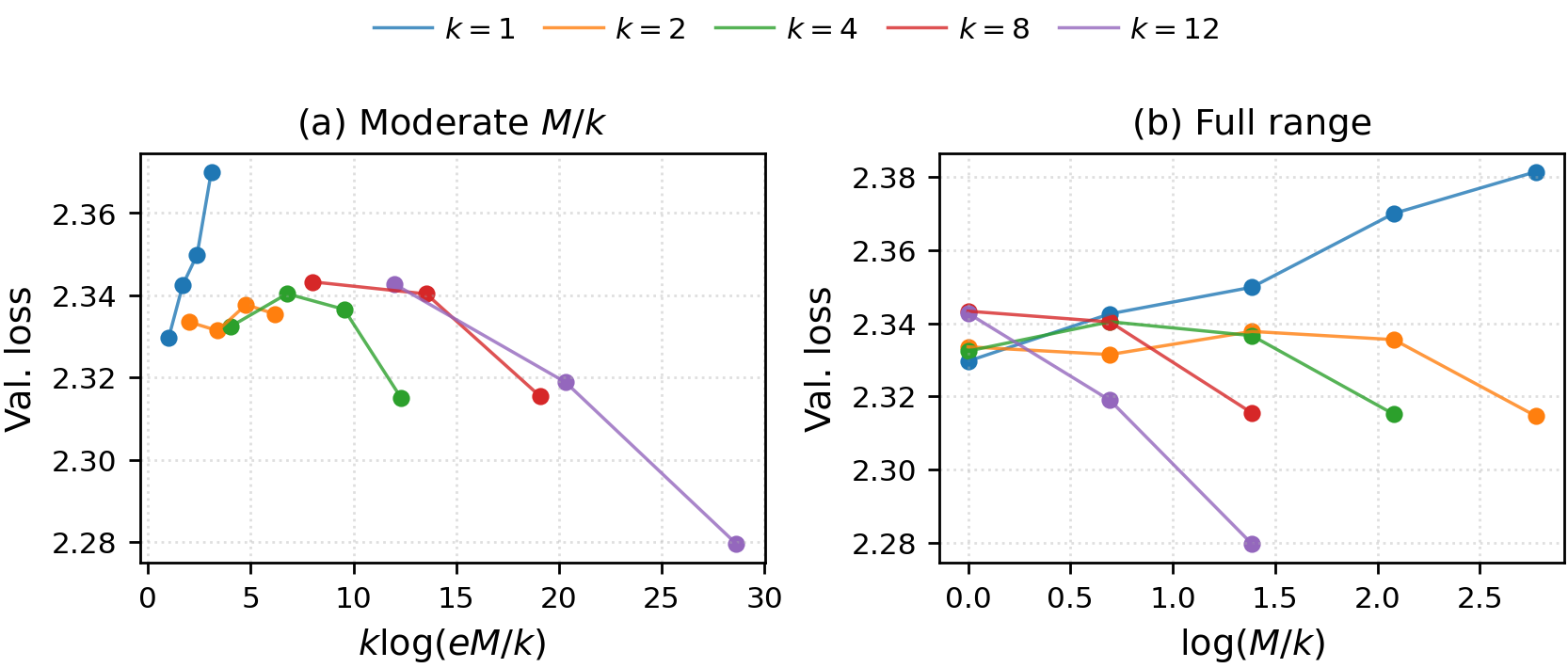
Worst-case theory predicts a routing overhead proportional to \(L_T \ell k \log(eM/k)\). This term says that increasing the number of possible routing choices can make learning harder from a uniform generalization perspective.
However, the empirical results also show a second effect: when the expert pool becomes sufficiently large relative to the number of active experts, performance may improve again. This suggests that expert specialization can provide gains not captured by the worst-case bound.
7. Practical interpretation
The result gives a useful way to reason about MoE design. Increasing the total number of experts does not automatically improve the worst-case statistical rate. In the worst-case bound, the main quantity is the number of active parameters, while the total number of experts contributes through a logarithmic routing term.
In practice, larger expert pools can still help when routing is structured and experts specialize. This explains why the theory should be read as a conservative reference point rather than a full description of practical MoE training.
8. What the paper contributes
- A statistical framework for MoE Transformers that separates active capacity from routing complexity.
- A generalization bound with approximation, estimation, and routing terms.
- Scaling laws for model size, data size, and compute-optimal tradeoffs.
- An interpretation of when MoE behaves like dense models and when routing/specialization effects matter.
9. Limitations and future directions
The bound is worst-case and therefore conservative. It does not fully capture optimization dynamics, routing stability, load balancing, or data-dependent specialization. A natural next step is to replace worst-case routing counts with more adaptive measures such as effective routing entropy or data-dependent routing complexity.