TRUSTIT project:
Theoretical and practical study of physical object security in real world use cases
January 2024 - December 2027
Description
The number of counterfeits is increasing by 3% per annum since 2016 according to the Association for Packaging and Processing Technology. This has become critical, since people are losing trust in the quality of medicines and food, as well as in the authenticity of the printed documents. Counterfeiting and forgery continue to proliferate partly due to the limitations of existing anti-counterfeiting technologies, that are either too easy to copy, too expensive to implement or too cumbersome to authenticate. The TRUSTIT project targets to build a novel authentication system for the security of physical objects (printed packaging or documents). We will focus on authentication systems based on the information loss during printing and digitalization, that have become mainstream thanks to their low cost of integration.
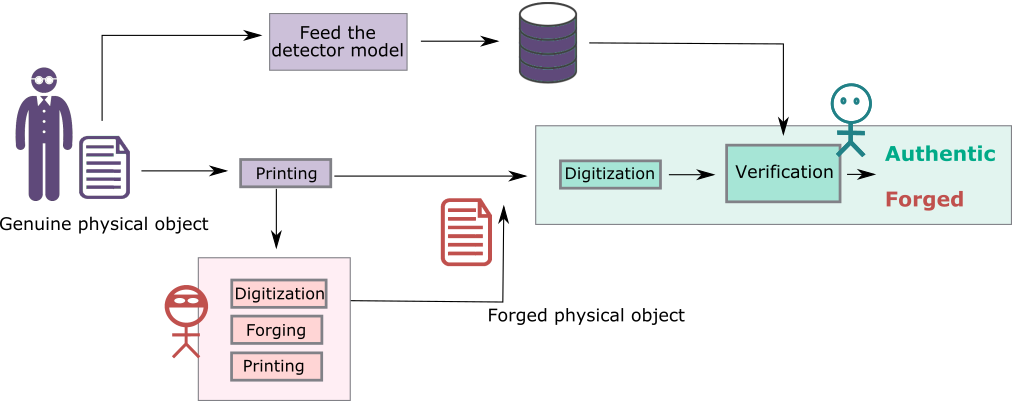
The objectives of the project are split on three parts:
- We will start by learning a surrogate representation of the degradations added by a given printer during the printing process (currently assumed as a physical unclonable function) using novel architecture of generative neural networks or diffusion model.
- We will construct a novel authentication detector based on similarity metric learning approach guided by forensic features and anomaly detectors.
- We will evaluation of the developed anomaly detector in real-world use cases.
The results of TRUSTIT project will contribute to the development of the authentication systems of the next generation that will equip citizens and industrials with the tools to verify the authenticity of products and documents, and by consequence improve their trust in goods and valuable documents.
Involved reserchers
- Iuliia TKACHENKO - Principal investigator in LIRIS, Lyon
- Carlos CRISPIM-JUNIOR - Collaborator in LIRIS, Lyon
- Bertrand KERAUTRET - Collaborator in LIRIS, Lyon
- Bolutife ATOKI - PhD Student on the topic "The investigation of an AI-based authentication detector for physical object security" (01/10/2024 - ...)
- Luc EUSTACHON - Intern on the topic "Diffusion models to create challenging graphical code counterfeits" (04-07/2026)
- Thierno Moussa DIALLO - Intern on the topic Mobile App Development for Image Capture (05-07/2026)
Publications related to the project
- B. Atoki, I. Tkachenko, B. Kerautret, C. Crispim-Junior, “Diffusion-Based Multi-Class Normality for OOD Detection: An Application to CDP Authentication”, AVSS 2026, September 2026, Lecce, Italy.[pdf][code]
- B. Atoki, I. Tkachenko, B. Kerautret, C. Crispim-Junior, “Diffusion-Based Authentication of Copy Detection Patterns: A Multimodal Framework with Printer Signature Conditioning”, WACV 2026, March 2026, Tucson, USA.[pdf]