Bati3D
3D modelling as a heuristic tool for reconstructing ancient built environments.
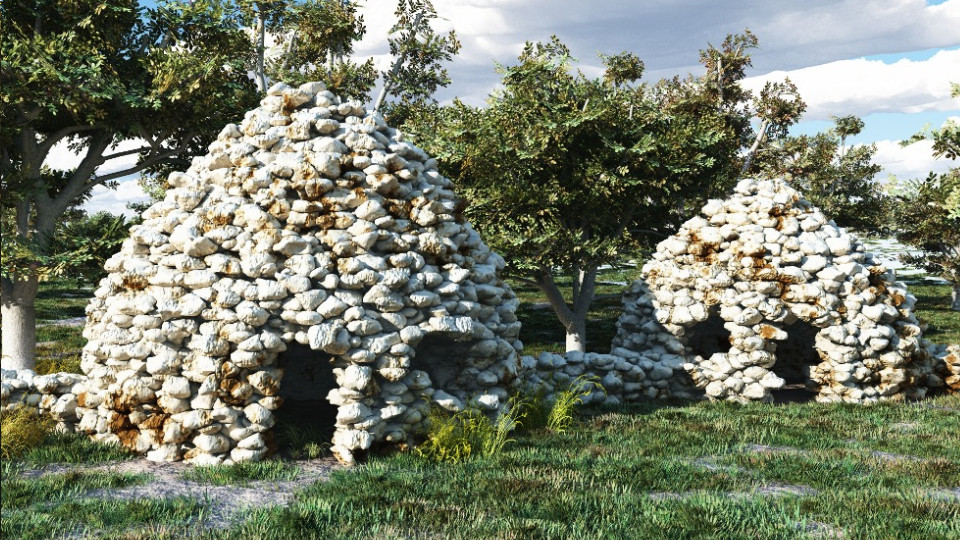
Bati3D contributes to the reconstruction of buildings from the pivotal 4th and 3rd millennia, the Chalcolithic and Early Bronze Age during which the first cities emerged in the Near East. Its originality is to treat 3D as a heuristic tool rather than as an illustration, and to open a new experimental ground for the generation of virtual worlds. Full title: La modélisation 3D comme outil heuristique dans la reconstitution du bâti ancien : approche ethnoarchéologique et expérimentation technique.
The project articulates three axes, creating a synergy between the humanities and computer science. The first draws on largely unpublished ethnographic documentation covering traditional settlements in Syria and Jordan that were still partly inhabited some thirty years ago, including plans, topographic surveys, photographs and interviews with residents. 3D becomes a means of projection for studying how space was lived in and occupied, from the single dwelling to the whole settlement, and for testing the validity of the elevations archaeologists reconstruct from truncated remains.
The second axis is the architectural and archaeological analysis of houses of the 4th and 3rd millennia, for which only partial excavation data survive: ground plans, a fraction of the original elevation, and a few domestic installations such as hearths. The aim is to reach reconstructions that are solidly grounded scientifically, and to consider pre-classical dwellings and settlements as spaces lived in and invested by people rather than as mere containers. Where the data are too thin for a single model, several reconstructions are proposed for the same building.
The third axis is technical experimentation, developing procedural generation protocols that turn footprint plans into volumetric reconstructions. The goal is to design computer graphics techniques that assist the creation of 3D models of archaeological and historical sites while staying faithful to field surveys and historical testimony.
Beyond its scientific results, the expertise and the models produced could serve the valorisation of an endangered traditional heritage, and open the way to virtual walks through traditional Eastern villages and pre-classical archaeological sites, which to our knowledge has not been done.
Scientific coordination: C. Castel (Archéorient).