GRAVID
Deep learning for detecting slope instabilities from terrestrial time-lapse cameras.
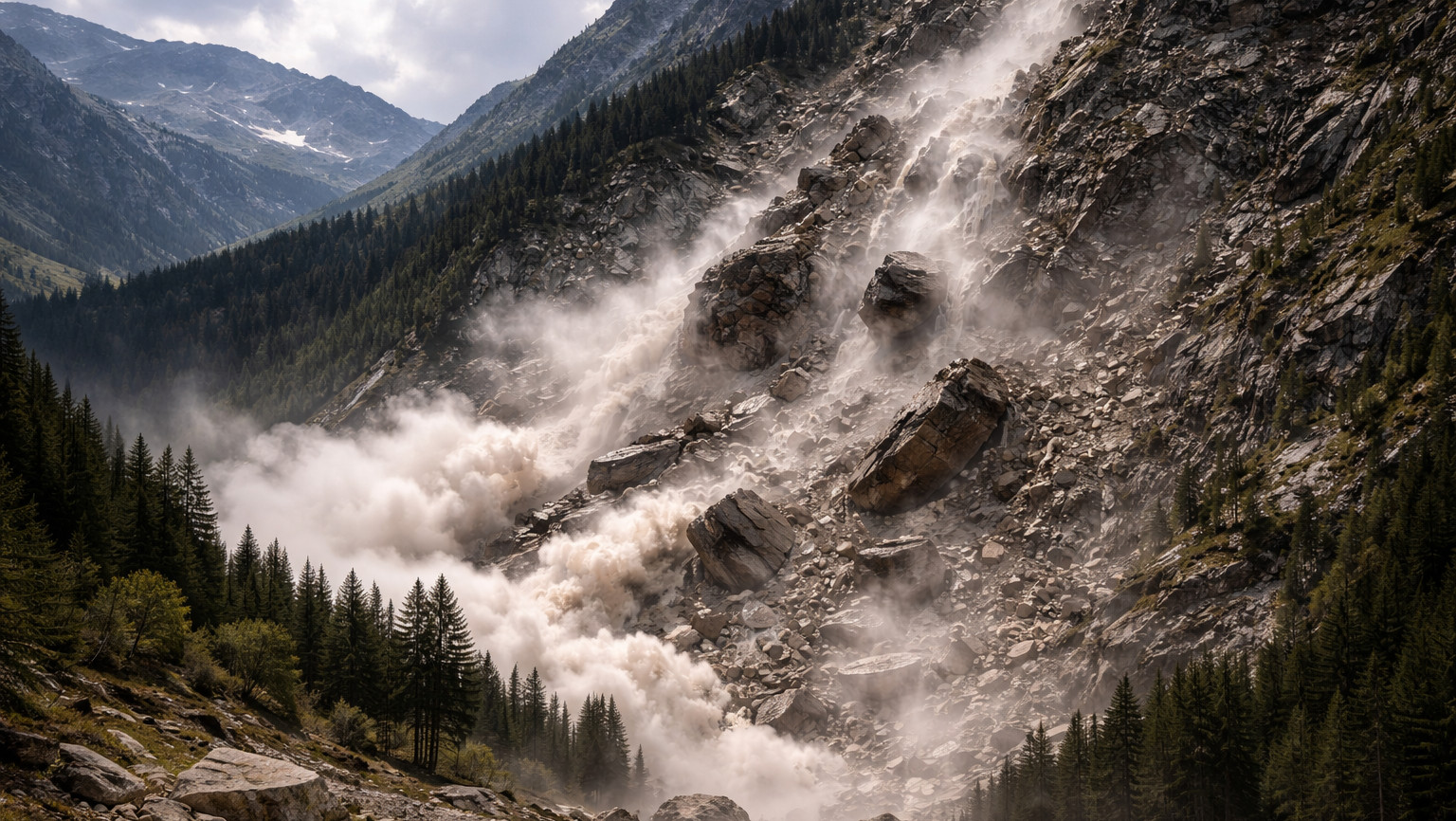
Gravitational hazards such as rockfalls, serac falls and landslides are a critical concern for mountain territories. The 2023 La Praz collapse in Maurienne still disrupts the rail link between France and Italy, and instabilities of the Planpincieux glacier regularly cut off the Val Ferret. Predicting when such events are triggered remains an open challenge: in-situ monitoring is hard to deploy on the most unstable slopes, and operational remote sensing such as interferometric radar is too costly for anything but the highest-stakes sites. Neither can be considered for large-scale coverage.
GRAVID develops deep learning methods that detect and quantify morphological change from monocular terrestrial time-lapse cameras, a far cheaper instrument that could be deployed broadly. I set the project up with Laure Tougne Rodet. It is the subject of Arthur Dérédel’s PhD, supervised by Laure Tougne Rodet and Carlos Crispim under a CIFRE agreement with Styx4D, and he contributes to the work described below. The main obstacle is training data: geomorphological change is rare, observing it requires image series spanning several years, and natural scenes bring abrupt changes of illumination, moving shadows and fog.
The Origami team contributes synthetic data. Starting from point clouds surveyed by Styx4D, the pipeline converts field data into 3D terrain models, enriches them with volumetric material properties, simulates rockfalls and their impacts on the scene, and extracts simulated image series suitable for training. A first proof of concept produced realistic renderings; the current work is the simulation of the rockfalls themselves.